
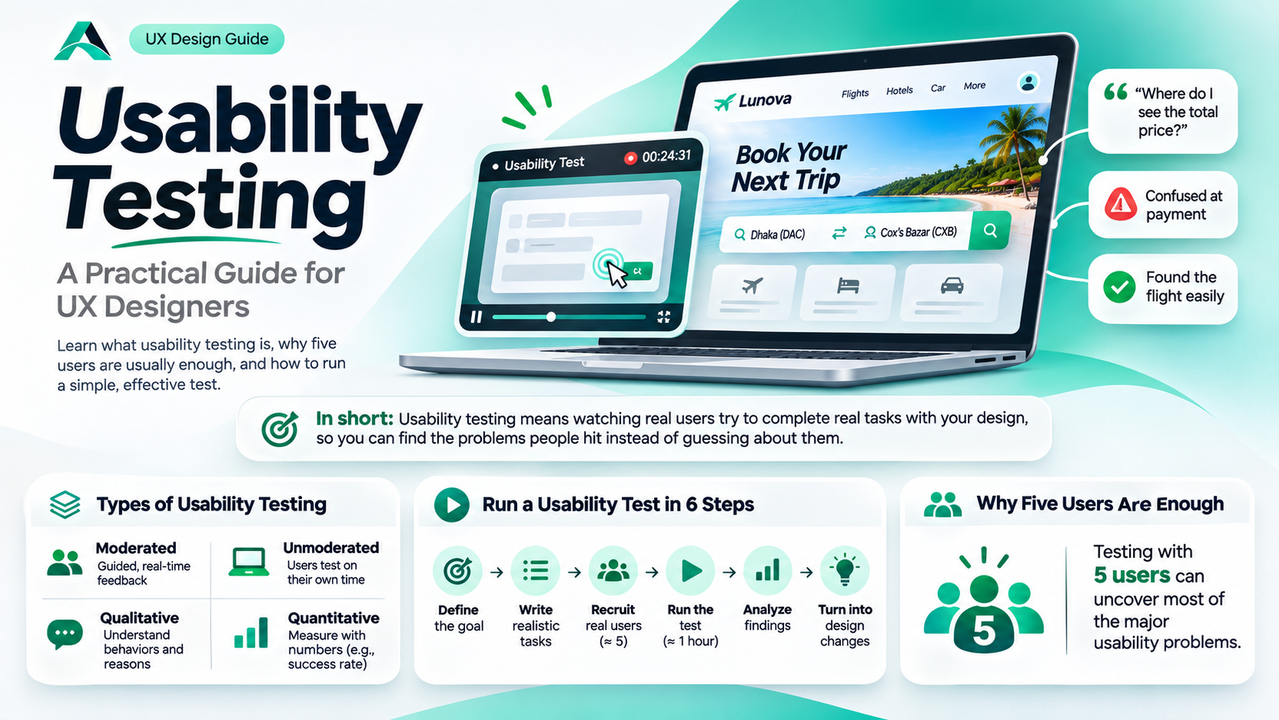
Watching one person try to use your design will teach you more than a month of debates about it. Here is what usability testing is, why five participants are usually enough, and how to run a small, honest test that reveals what users actually do.
In short: Usability testing means watching real users try to complete real tasks with your design, so you can find the problems people hit instead of guessing about them.
Why Testing Beats Opinions
Every design team has had the meeting. Two confident people disagree about the checkout flow, the argument circles for an hour, and nobody has new information at the end. Opinions do not resolve opinions. Watching users is how you break the tie.
Usability testing is the closest thing design has to a referee. Instead of asking people what they think of a design, you give them a task and watch what they do. The gap between what people say and what people do is where most usability problems hide. As the Nielsen Norman Group puts it, even the best UX designers cannot design a perfect experience without iterative design driven by observations of real users.
Tests also surface problems no meeting could predict, like the moment users freeze in front of too many options, the decision paralysis behind Hick's Law: Why Fewer Choices Help Users Decide Faster.
The encouraging part is the size. A good test is small. You do not need a lab, a large budget, or twenty participants. Five people, a quiet room, and an hour each can uncover most of the serious problems in a design. This article shows how to run a test like that.
What Is Usability Testing?
Usability testing is a UX research method in which a facilitator, sometimes called a moderator, asks a participant to perform realistic tasks with a design while observing their behaviour and listening to their feedback. Participants are usually asked to think aloud, narrating their thoughts and actions as they go, so the team can understand not just what happens, but why.
A usability test has three core elements. The facilitator guides the session, gives instructions, asks follow-up questions, and works hard not to influence the participant. The tasks are realistic activities the participant might perform in real life, written as scenarios rather than step-by-step instructions. And the participant should be a realistic user of the product, or at least someone with similar needs.
Tests come in a few useful varieties, and choosing the right one depends on what you need to learn:
| Type | What it is | Best for |
|---|---|---|
| Moderated | A facilitator is present, in person or over a call, guiding and probing in real time | Understanding why users struggle, testing early or complex designs |
| Unmoderated | The participant works alone through written tasks on their own time; the researcher reviews recordings later | Quick feedback on simple, stable flows from more participants |
| Qualitative | Collects insights and anecdotes about how people use the product | Discovering problems; the most common kind of testing |
| Quantitative | Collects metrics such as task success rate and time on task | Benchmarking one design against another or over time |
Most designers spend most of their time with moderated qualitative testing. It is the cheapest way to discover what is wrong, and it works at every stage, from paper sketches to the shipped product.
Why Five Users Are Enough
One of the most quoted findings in UX comes from Nielsen Norman Group: for a typical qualitative usability study of a single user group, testing with five participants uncovers the majority of the most common problems in the product. The logic is simple. The first few users find most of the big issues. By the sixth or seventh, you are mostly watching people hit problems you already know about, while undiscovered problems get increasingly rare. Each extra participant adds less new information than the one before.
A simple discount usability study, as NN/g calls it, can be planned in a day, run in a day, and analyzed in a day. Three days of work, and you have findings worth redesigning for.
There are limits. Five is the number per user group. If your product serves very different audiences, each group needs its own small test. Quantitative studies that aim for statistical confidence need more participants too. But for discovering what is wrong with a design, small beats large, and soon beats late.
How to Run Usability Tests in Six Steps
1. Decide what you want to learn. Write down one or two research questions before anything else. "Can first-time users complete the booking flow without help?" is a question. "Get feedback on the redesign" is not. Your questions set your tasks.
2. Write realistic tasks as scenarios. Tasks should be goals, not instructions. Write "Book a flight from Dhaka to Cox's Bazar for next Friday," not "Click the search tab, enter the dates, and click search." Never use interface labels in the task wording, because that gives away the answer. Keep it to five tasks or fewer in a session of about an hour.
3. Recruit real users. Five people who resemble your actual users. Friends, colleagues from other teams, and friendly customers all work. Screen for the target group, offer a small incentive, and make clear you are testing the design, not them. People blame themselves for design failures, and you need them relaxed enough to fail honestly.
4. Set up a simple observation space. A quiet room, a laptop or phone with the prototype, and a screen recorder. Invite stakeholders to watch silently, from the room or a shared link.
5. Facilitate: watch, do not help. Welcome the participant, explain that the design is being tested and not them, and ask them to think aloud, saying what they are doing and thinking as they do it. Read each task scenario aloud. Then be quiet. Take notes on what they do, where they hesitate, what they misread, and what surprises them. Save your questions for follow-ups between tasks.
6. Analyze, prioritize, and iterate. Watch the recordings, collect every problem, and note its severity: how many users hit it, and how badly it blocked them. Three severe problems that all five users hit beat thirty cosmetic nits. Turn each problem into a redesign recommendation. Then fix and test again. The process is iterative: test, fix, test, fix.
Facilitation Rules That Keep Tests Honest
The think aloud protocol, asking participants to narrate their thoughts and actions, is one of the most valuable techniques in UX. It reveals what participants are thinking before they forget or rationalize it.
Facilitation is a skill, and its central discipline is neutrality. When a participant is stuck, your instinct will be to help. Do not. The moment you guide them, the test no longer measures the design; it measures your instructions. Instead, ask neutral follow-ups. "What are you expecting to happen here?" If they ask how something works, bounce it back: "What would you expect it to do?" Their expectation is the finding.
A few rules that keep sessions honest:
- Never defend the design. "We meant it that way" ends the conversation.
- Never say "most people do it this way." There are no other people in the room.
- Take notes on behaviour first, quotes second. What they did is the finding; what they said explains it.
- End each session by asking what frustrated them most. It is often different from what you observed.
Remember: a usability test is not there to prove your design is good. It exists to find where the design breaks, as cheaply and as early as possible, so you can fix it before real users pay the price.
Common Mistakes
Running a survey instead of a test. Asking people to rate a design tells you what they claim. Watching them use it tells you what happens. Only observation reveals usability problems.
Leading the participant. If your task says "use the filters to find a direct flight," you have given away the answer. Realistic scenarios keep the test measuring the design, not the instructions.
Testing with the people who built the feature. They know too much. If nobody from the real audience is available, use colleagues from unrelated teams, and say so honestly in the report.
Testing only at the end. The later you test, the more expensive every fix becomes. Test the prototype, the wireframe, even paper sketches. A rough design tested early beats a polished design tested late.
Counting opinions instead of problems. Five users is for discovering problems, not votes. If two users loved a feature and three could not find it, the feature fails. Testing finds what breaks, not what wins.
FAQs
When in the process should I run a usability test?
Early and often. Test sketches and wireframes to catch structural problems while they are cheap to fix, test prototypes to validate flows, and test the shipped product to catch regressions. One test at the end of the project is the most expensive and least useful place for it.
Should I run moderated or unmoderated tests?
Use moderated tests when you need to understand why something happens, which is most of the time during design. The facilitator can probe and catch subtle moments a recording alone would miss. Use unmoderated tests when the design is stable enough for written tasks and you want quick feedback from more people. Many teams use both: unmoderated for breadth, moderated for depth.
Key Takeaways
- ✓ Usability testing means watching real users complete real tasks, not asking them what they think.
- ✓ Five participants uncover most common problems in a qualitative study of one user group.
- ✓ Write tasks as realistic scenarios, never step-by-step instructions.
- ✓ Facilitate neutrally with the think aloud protocol: watch, ask, and never help or lead.
- ✓ Test early and iterate. Test, fix, and test again.
- ✓ Three severe problems everyone hits beat thirty cosmetic nits. Prioritize by severity.
Conclusion
User testing is the least glamorous and most honest tool in UX. It does not need a lab, a big budget, or permission from a research department. It needs five people, five good tasks, one quiet room, and the discipline to watch without helping.
Teams that test regularly carry that honesty into their products, because someone watched a stranger get confused and refused to let the next user have the same experience. Start this week. Pick one flow you are unsure about, find five people, and watch. What they do will change what you design next.
References and Further Reading
- Usability Testing 101, Nielsen Norman Group
- What is Usability Testing?, Interaction Design Foundation

Written by
Md Arshak Hossain Zahid
UI/UX Designer · Founder of ArshakUIX
Practical insights on UX laws, usability, design systems, and product design.